Why did you decide to volunteer for the Welcome Group Program in Winnipeg?
My previous job involved working from home and I wanted to make a career transition. At the same time, when I got my citizenship, I suddenly did not have to worry about immigration papers. I realized I wanted to spend time helping people who just moved to Canada. I’ve been here for about 12 years and it’s been rewarding to think about how far I’ve come. I have struggled with imposter syndrome and I’ve thought about how people from similar backgrounds might experience those worrisome thoughts.
One of the funny things I always remember was when I first moved to Vancouver. I was jaywalking because I didn’t know there was a pedestrian light. It was a “lightbulb moment” because people were looking at me weird. I asked someone if there were rules for crossing the street. At the time, I was only 21 and I grew up very sheltered. I lived in Saudi Arabia and Egypt and neither of them had these rules.
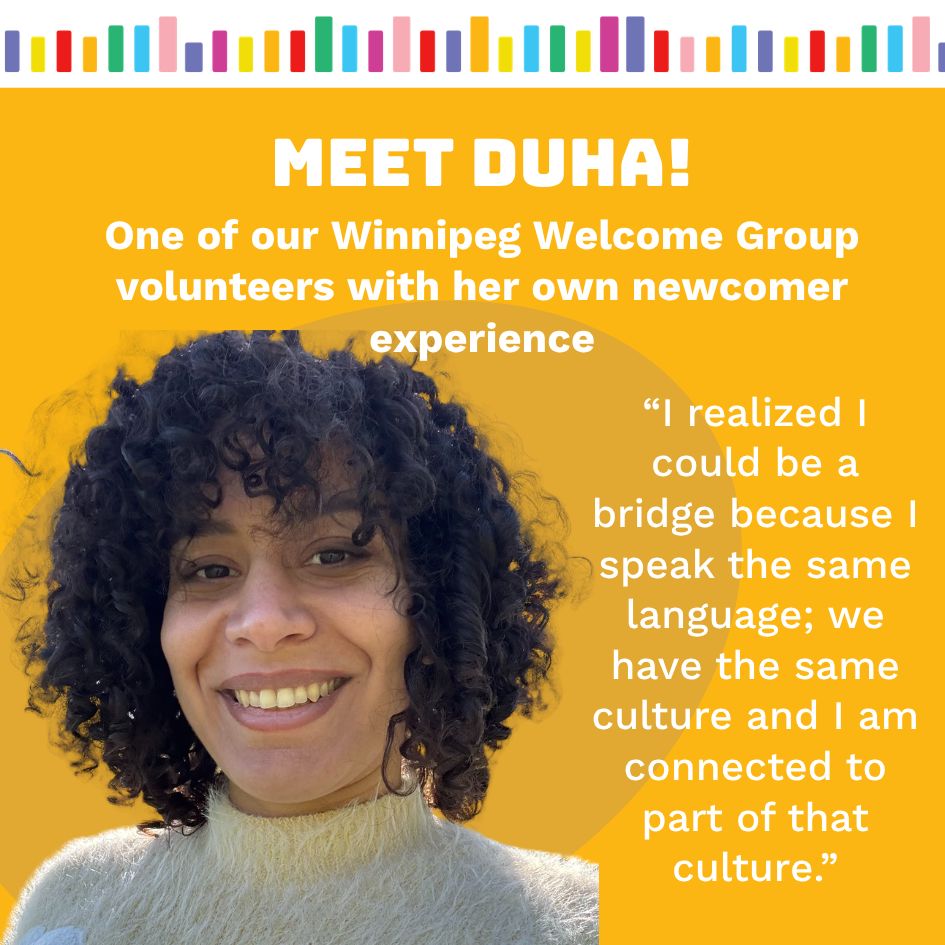
I think now about how many things I take for granted versus people who come here and do not know. And I realized I could be a bridge because I speak the same language; we have the same culture and I am connected to part of that culture. Also, I’m married to a Canadian. I have learned so much and I can propagate that knowledge. These are some of the reasons why I wanted to volunteer.
How does your personal background shape your approach to assisting newcomers?
One benefit I have in speaking Egyptian Arabic is that it is easier for newcomers to feel a sense of familiarity with me as Egyptian cinema is popular. Egyptians also have built-in humor to cope with life. As the main translator for my match introduction, I was able to lighten the mood with my humour. Staying professional but not fully serious all the time is something unique I bring to volunteering.
Another thing I bring is, “I’ve been in your shoes before.” When I came to Canada, I lived in Vancouver by myself before I moved to Montreal with my family. While in Vancouver, it was more of a seamless experience because there was no language barrier. With moving to Montreal, I felt more visible because of the language barrier at the time, which made me self-conscious of my culture too because it was a lot harder to blend in. I was suddenly too aware of my existence in a way that made me uncomfortable in my skin. I have worked on exploring the themes of why I felt “exposed’ in that sense, and how my existence is just as valid as anyone around me, even with all those differences.
There was also a period where I experienced an identity crisis; when I felt I am not Canadian enough, not Egyptian and not Saudi enough. I have come to realize that it was different parts of me that resonate with each, and that was what made me who I am. So in my matches, I want to help pave the way for the evolution of the version of “you” you want to nourish and continue with. Whatever you need help with, I’ve got you.
What have you learned about the challenges and opportunities newcomers face when rebuilding their lives in Winnipeg?
Navigating the system without having the language is a very big challenge. Having the ability to be an intermediary point where they trust what I translate and know that I have their best interests at heart – I can look for resources and help a family navigate. I can fully relate to the challenges with the status and that feeling of, “What can I do to ensure my family is well fed, can find medical spaces and knows where to live?” Not having access to that basic information because it’s not in English is very difficult.
Feeling homesick is another really big challenge as well. Sometimes people do not come here by choice. Yes, it’s a better space but there are friends or family or extended family back home that either don’t want to join or are stuck in a period of waiting for their time to arrive. Navigating those spaces where you feel homesick but don’t feel connected because the community here is not the same or you are still building it; those are some of the most prominent challenges I see.
What were the highlights of volunteering in the program?
In terms of high points, yes, I am helping them but also, they are helping me have a feeling of a familiar family as mine is spread between Montreal and Toronto. The geniality I have been shown has been very heartwarming. The pleasantries, the hospitality, the love, I’ve known one of my matches for two months but already, we feel like a family. That built-in trust where my knowledge is facilitating what they need here and they are reminding me of what it is like to be back home. I also rarely used the Arabic keyboard growing up because I was more used to the Franco Arabic format of communicating. So improving my typing speed to be able to communicate with my refugee family got me in touch with that part of my culture growing up again – those are some of the highlights of my experience in the program.
What advice would you give to others thinking about volunteering for the Welcome Group Program?
I would say, walk in with an open heart and be ready to receive the rewards of that openness that you give to other people.